
By Lukas Overhaug, Owner, Integrity Concrete Coatings
Published
We install across Northern Illinois, from Rockford and DeKalb to the Fox Valley and the western suburbs. See where we work.
01Read this if you read nothing else
The short answer
Polyaspartic vs epoxy comes down to what the floor has to live through. In a Northern Illinois garage that means hot tires, road salt, sunlight through an open door and a slab that moves every winter. At Integrity Concrete Coatings we install a polyurea base with a polyaspartic topcoat, and it is what we recommend for most floors, especially in homes. Epoxy is a single-chemistry resin coating, and we install it on some commercial jobs where it suits the space.
The practical differences in a polyaspartic coating vs epoxy are easy to list. Our system installs in one day where epoxy often takes two to four. The polyaspartic topcoat is UV stable, so it does not yellow the way epoxy can. The polyurea base flexes as the slab moves through freeze-thaw, where rigid epoxy is more likely to crack or chip. And installed properly, the system resists hot tire pickup.
For the longer version of our reasoning, read why we recommend polyurea over epoxy. The rest of this page walks through the chemistry, the install, winter, cost and the ways epoxy fails. If you already know what you want, you can get a free quote.
- to install our system, start to finish
- 1 day
- until vehicles and heavy items go back in
- 72 hrs
- base coat adhesion, ASTM D4541, concrete failure
- 400+ psi
- per sq ft for most garages and patios, basements from $7
- $6-$10
02The chemistry, in plain terms
What polyurea, polyaspartic and epoxy actually are
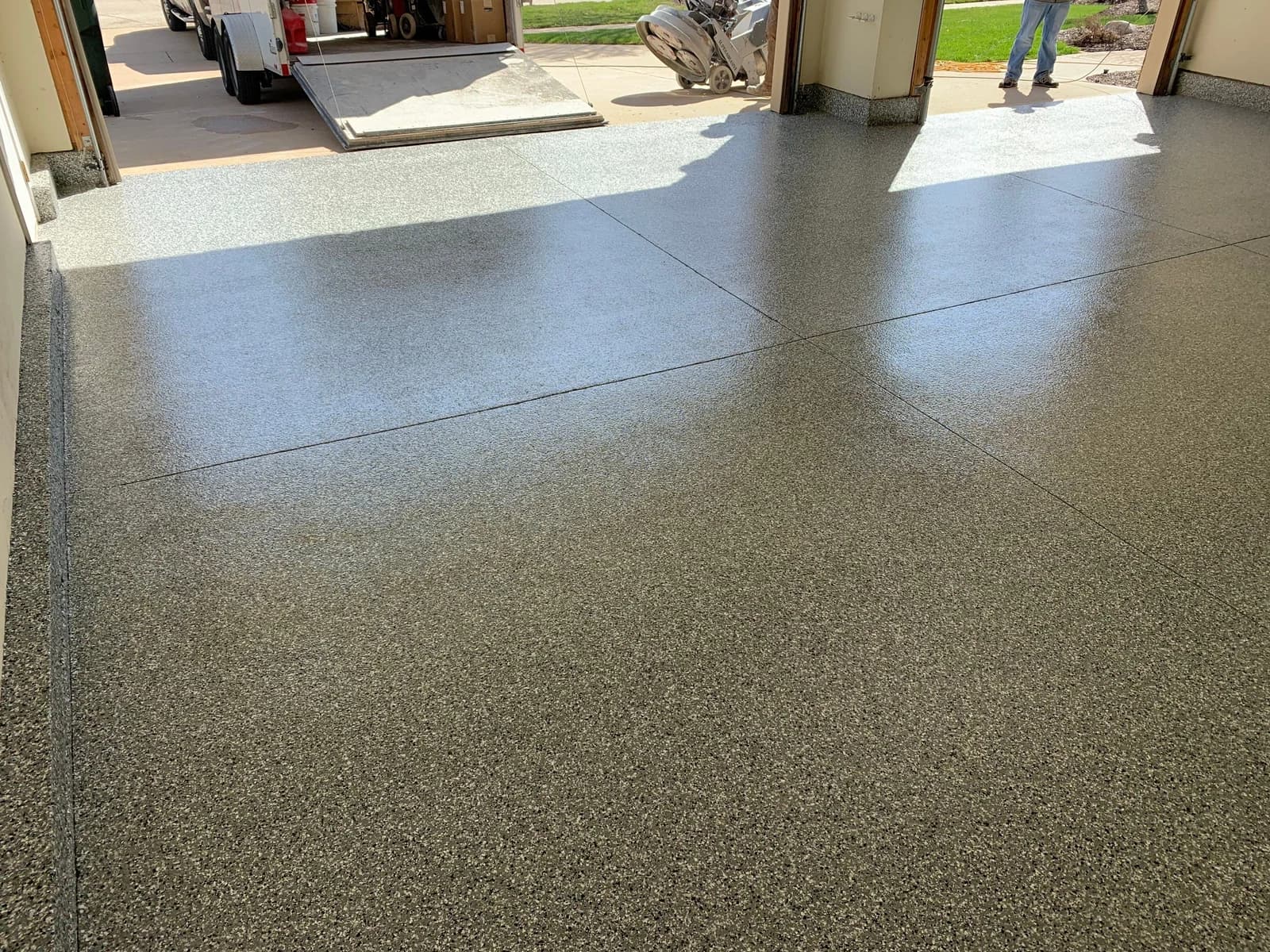
Our system has two layers that do different jobs. We use a high-elongation polyurea basecoat that bonds aggressively to prepared concrete, followed by a full flake broadcast and a hard, UV-stable polyaspartic top coat. The base provides flexibility and adhesion, while the topcoat provides the hardness, abrasion resistance and protection the finished floor needs.
Inside the floor
Four layers, top to bottom. Tap one to lift it out.
Clear, hard and UV stable. It takes the abrasion and the hot tires, can resist oil, gasoline and road salt, and keeps its color where sunlight comes through the door.
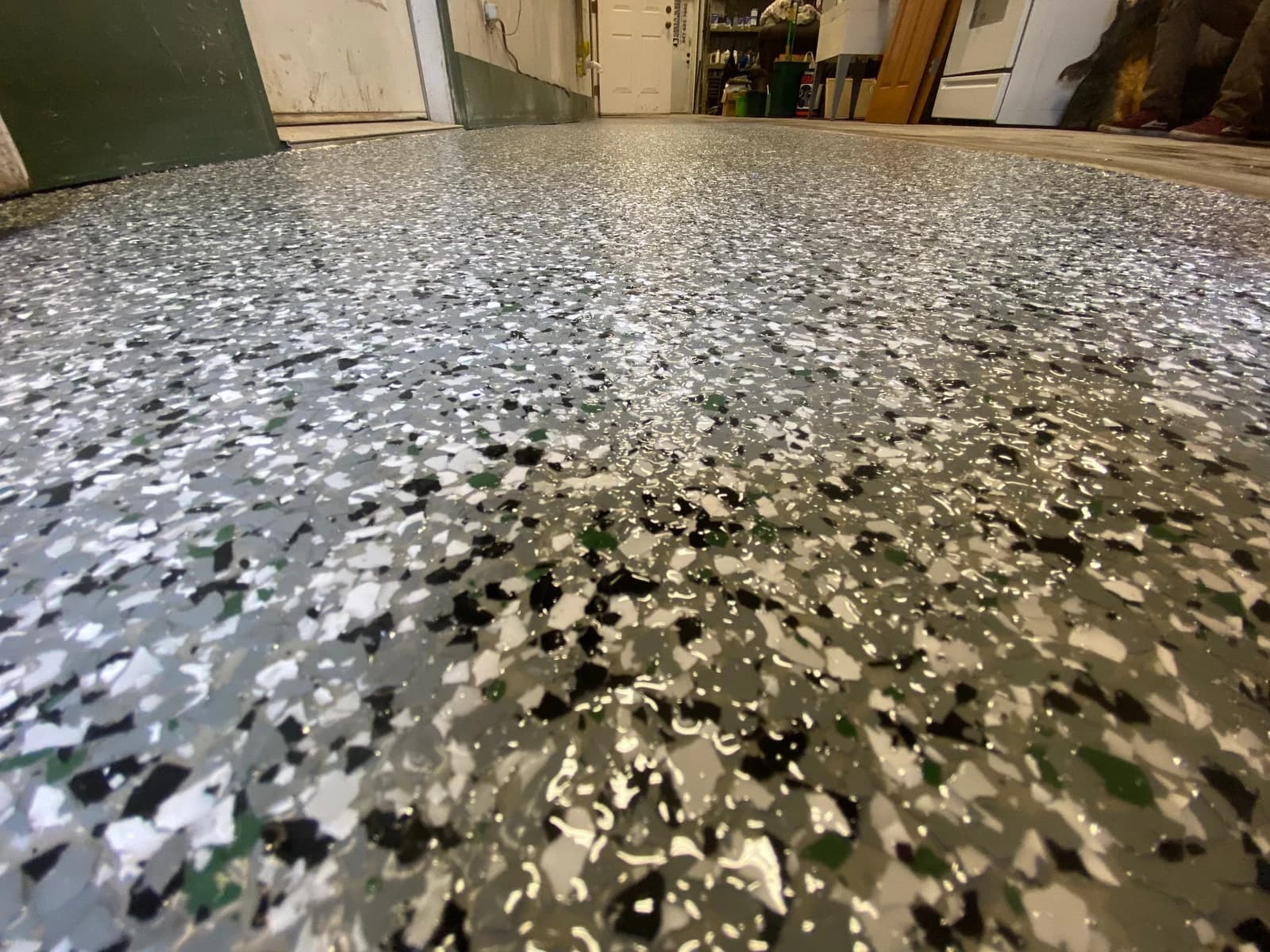
Colored flake is broadcast into the wet base coat until the surface is covered. It gives the floor its color and texture. See the finish options.
High-elongation, so it flexes as the slab moves. It bonds to the ground concrete, and in the ASTM D4541 pull-off test reported on the product data sheet, it held at more than 400 psi.
Diamond ground and vacuumed before anything goes down, so the base has clean, open concrete to hold onto.
Polyurea, the base coat
Polyurea is a two-part coating that cures fast and stays flexible once it has cured. We use it as the first layer because it grips prepared concrete and can move a little with the slab. High-elongation means it can stretch before it lets go, which is the property you want under a floor that sees a Northern Illinois winter.
In the ASTM D4541 pull-off test on the product data sheet, our basecoat held at more than 400 psi. When the test pulled hard enough to break something, the concrete underneath gave way before the bond did.
That is also why prep matters so much. The base can only hold onto concrete that has been ground open and cleaned, so every one of our installs starts with the grinder.
For the base coat on its own against epoxy, read polyurea vs epoxy.
Polyaspartic, the topcoat
Chemically, polyaspartic belongs to the polyurea family, and our topcoat is formulated to stay stable under UV light, which is why it keeps its color and gloss where the sun comes through the garage door.
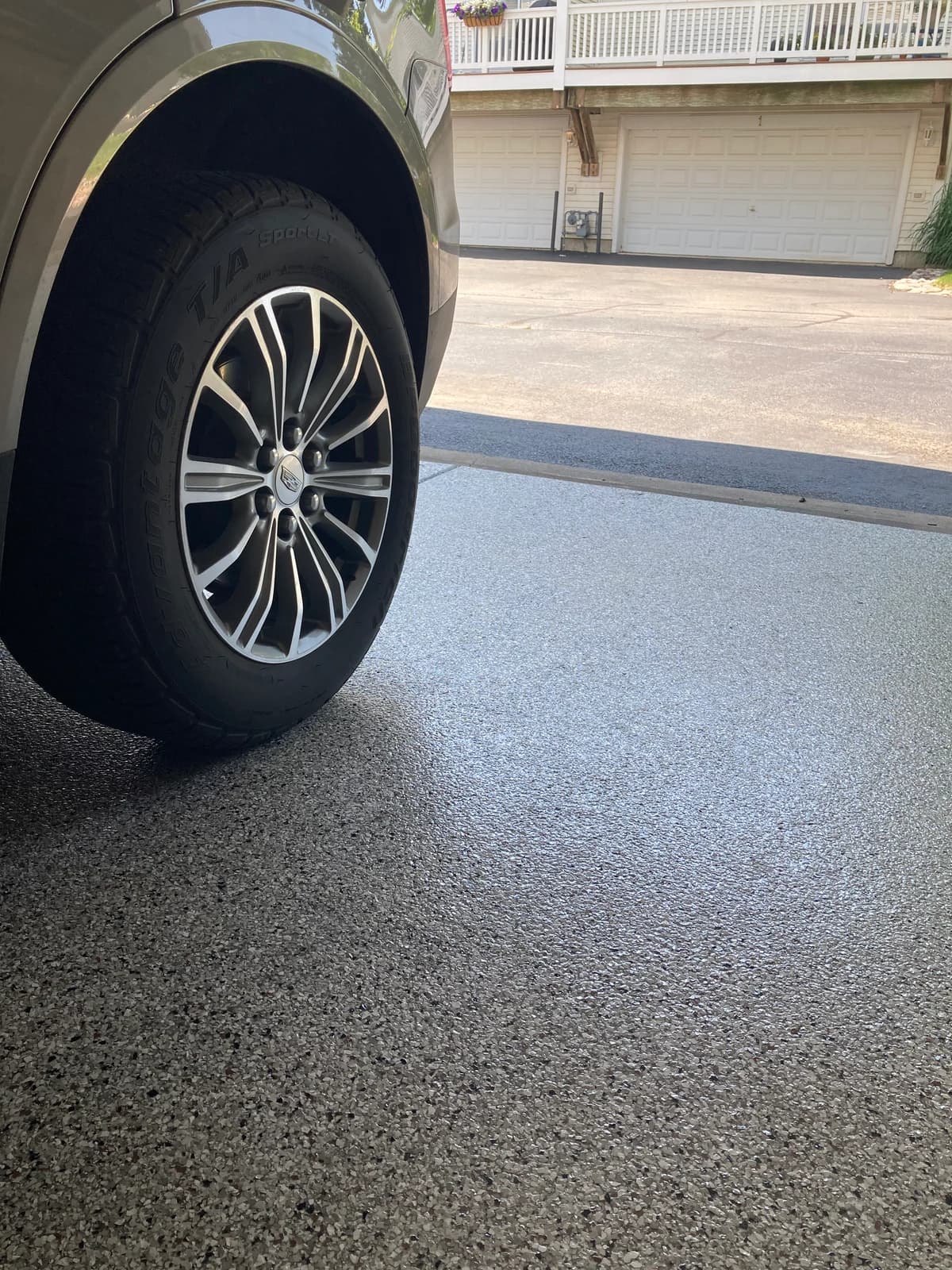
We use it as the clear top layer because it is hard, it resists abrasion and it seals the flake in. It can also resist oil, gasoline and road salt, which covers most of what drips off a car. Fertilizer and harsh household chemicals can mark it, so we advise keeping them off the floor.
Epoxy
Epoxy is a two-part resin that cures hard and rigid. It has a longer cure window, so an epoxy floor often takes two to four days to install. Its weak points show up over time. Many epoxies amber or yellow in sunlight, and a rigid film has little give when the concrete under it moves.
Epoxy still has a place. On some commercial jobs it suits the space better, and we install it there. For a home in Northern Illinois, we think the two-layer system is the better floor.
Two layers, two jobs
Polyurea and polyaspartic are related chemistries, and people often ask whether they are the same thing. They are close relatives doing different work. If you are weighing polyaspartic vs polyurea for your own floor, the useful answer is that our system uses both: the base does the gripping and flexing, and the top takes the wear.
A floor built from one product has to do both jobs with a single layer. Ours splits the work between two, and that is the whole reason we build it this way.
03Nine features, one table
Polyaspartic vs epoxy, side by side
The left column describes the system we install. The right column describes epoxy as a material class, not any specific product, because epoxies vary from one maker to the next.
| Feature | What we installPolyurea base with polyaspartic topcoat | General material behaviorTraditional epoxy |
|---|---|---|
| Installation | One day | Often 2 to 4 days |
| UV stability | UV stable, keeps its color and gloss | Can yellow in sunlight |
| Flexibility | Flexible, expands and contracts with temperature | More brittle |
| Impact resistance | Handles dropped tools and heavy equipment | More prone to chipping |
| Hot tire pickup | Resists hot tires when installed properly | Can experience hot tire pickup |
| Cure speed | Fast cure | Slow cure |
| Chemical resistance | Can resist oil, gasoline and road salt | Good, but generally less resistant |
| Freeze-thaw climates | Built for freeze-thaw movement | More susceptible to movement-related failures |
| Installation temperature | Installs year round, including below freezing | Needs warmer conditions |
One note on the cure row. Fast cure means the coating sets quickly enough for us to finish the whole install in one day. It does not mean the car goes back in that evening. The next section has the hours.
Not sure which one your floor needs?
We will look at the concrete, tell you which system fits and give you a written quote. The assessment is free.
Not sure what you are looking at?
Text us a photo of the floor.
Send a picture of the spots that worry you to (815) 605-1351 and we will take a preliminary look before anyone comes out. If the floor needs a closer look, the in-person assessment is free.
04One day on site, three days to full use
How long the install takes, and when you get the floor back
Most of our installs take one day, start to finish. In the morning we prep the slab with diamond grinding and vacuum up the dust. Midday the polyurea base goes down and we broadcast flake into it until the surface is covered. In the afternoon we scrape the floor, clear the loose flake and roll on the clear polyaspartic topcoat. Polyurea cure time and polyaspartic cure time are the two questions we hear most, and on our installs they have one answer, because both layers go down on the same day and the floor comes back on one schedule.
- Step 1, Morning
Morning: we grind and clean the slab so the base coat can grip it
- Step 2, Midday
Midday: the polyurea base goes down and the flake is broadcast into it
- Step 3, Afternoon
Afternoon: the clear polyaspartic topcoat seals the floor
Getting the floor back happens in three steps, counted from when we finish:
- 24 hourswalk on it.
- 48 hoursmove small items back in, anything under 100 pounds.
- 72 hoursheavy items and vehicles. The floor is back in full use.
In winter the cure can take longer. The longer cure does not harm the floor. It only means a little more waiting before you move back in.
An epoxy install often takes two to four days. That is where our system saves you time: the install itself, not the wait afterwards.

Cure clock
Drag to see what you can do, and when
after we finish
Still curing
Stay off the floor. Cold weather can stretch this part, and the longer cure does not hurt anything.
Walk on it
Small items back
Vehicles and heavy items
05Where the Midwest changes the answer
Built for Midwest Winters
A slab in Sycamore or Rockford is not the same slab in January that it was in July. Concrete expands and contracts with the temperature, and water that gets into it freezes and pushes. A rigid coating rides on top of all that movement with nowhere to go, which is why epoxy in freeze-thaw climates is more susceptible to movement-related failures: cracks, chips and edges that start to lift. Our polyurea base is flexible. It expands and contracts with the slab, so the floor stays in one piece.
A slab with a control joint
Cycles: 0/4
Simplified illustration. Movement is exaggerated so you can see it.
Press Run a winter to watch a rigid film ride on a slab that moves.
Then there is the salt. From the first snow until spring, every car that pulls into a DeKalb County garage drips slush and road salt off its wheel wells. Bare concrete soaks that brine up. Our polyaspartic topcoat is non-porous, so the salt water sits on top until you squeegee it out, and the coating can resist road salt along with oil and gasoline.
The last difference is the calendar. We install year round, including when it is below freezing. Cold weather can make the coating take longer to cure, and that does not harm the floor. Epoxy generally needs warmer conditions, so an epoxy installer in the Fox Valley often has to wait for them.
We coat floors through the whole winter, with crews working on concrete coatings in Sycamore, garage floors in Rockford, floor coatings in DeKalb and Aurora concrete coatings.
06What you pay, and how often
What polyaspartic vs epoxy costs over the life of the floor
Most garage floors and patios we coat come in at $6 to $10 per square foot, and basements start at $7. Every job has a $2,200 minimum. Pool decks can run higher, and so can any project that needs heavy concrete repair or an old floor covering removed first. For the full breakdown, see what polyaspartic floor coating costs.
Ballpark calculator
How big is the floor?
Length times width, in feet. A 20 by 22 foot floor is 440 square feet.
Typical range for this size
$2,640to$4,400
Based on $6 to $10 per square foot, which covers most garage floors and patios we coat. New, sound concrete lands near the $6 end. Every job has a $2,200 minimum.
A ballpark only. Your quote comes after a free look at the floor.
Epoxy often costs less to put down. The comparison that matters is how many times you pay for it. A floor that yellows, peels or picks up under hot tires gets recoated, and every recoat is another bill and another few days with the room out of use.
One day. Lifetime performance.
With proper maintenance, the floor can last a lifetime. Residential floors under a roof, garages included, carry a lifetime warranty, backed by The Integrity Seal. Patios, pool decks, porches, walkways, garage aprons and commercial floors carry a 3-year warranty with the same coverage. The lifetime warranty transfers to the next owner of the home.
Want a number for your own floor? Book a free floor assessment and we will measure it and give you a written quote.
07Four ways it goes wrong
Stop repainting your garage floor: how epoxy fails
Here are four ways epoxy gives out in a Northern Illinois garage. Each one describes epoxy as a material class in the conditions a garage here puts it through. It is not a verdict on any particular product, and it is not a claim that epoxy fails everywhere.
From our job files
An old garage floor our crew removed
The coating is gone in patches, with bare concrete showing through across the slab. The finder below matches what your floor is doing to one of the four ways epoxy gives out.
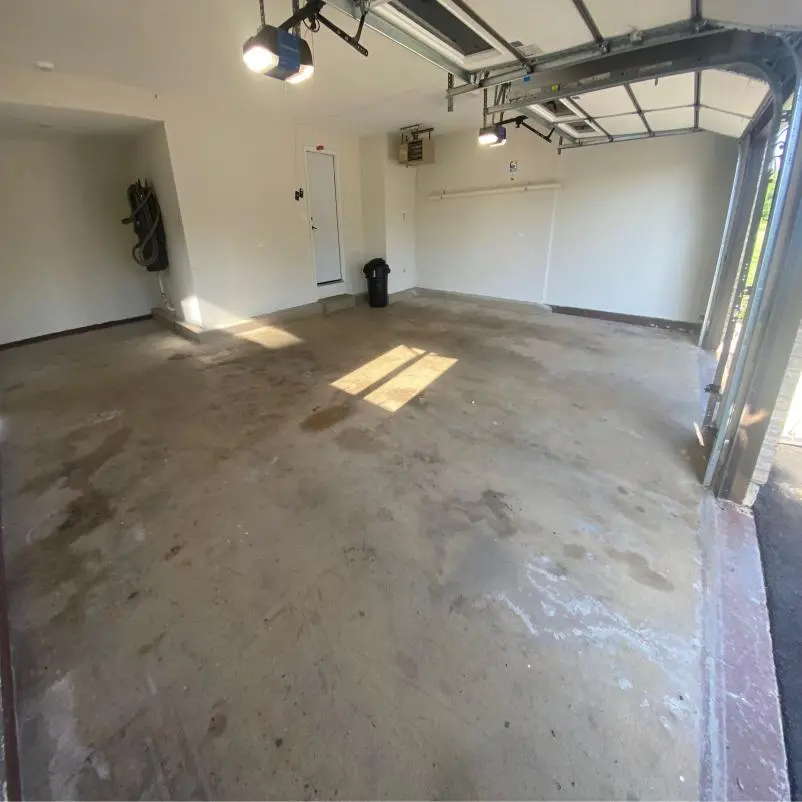 Before removal
What is your floor doing? Tap one.
Failure 01
Yellowing and ambering
Many epoxies amber under UV light. It shows first on the strip of floor inside the garage door where the sun reaches, so the floor ends up two colors.
What our system does
Our polyaspartic topcoat is UV stable. It keeps its color and gloss where sunlight hits the floor.
Failure 02
Hot tire pickup
Tires come home hot. Park on a coating that softens with heat and it grips the tread, and when the car backs out, patches of coating leave with the tire.
What our system does
Installed properly, our system resists hot tire pickup. The hard polyaspartic top takes the heat and the wear.
Failure 03
Peeling and delamination
Most peeling starts with prep. A coating rolled onto concrete that was never ground open has little to hold, and water, salt and traffic work it loose. DIY epoxy kits are prone to it, since the prep is left to whoever bought the kit.
What our system does
We diamond grind every slab first. In the ASTM D4541 pull-off test on the product data sheet, our basecoat held at more than 400 psi, and the concrete broke before the bond did.
Failure 04
Chipping from impact
Epoxy cures hard and brittle. Drop a wrench or a trailer jack on it and the film can chip, and every chip is a new edge for water and salt to get under.
What our system does
Our system handles dropped tools and heavy equipment: flexibility from the base, hardness from the top.
Epoxy floor peeling, lifting or yellowing?
Call us or request a quote and tell us what the floor is doing. We will look at it during the free assessment and tell you whether it needs a recoat or a full replacement.
08Surface by surface
Which system fits which floor
Commercial strength. Residential beauty. The same two-layer system goes on most of the floors we coat. What changes from one surface to the next is the finish and the length of coverage. Residential floors under a roof, garages included, carry a lifetime warranty, backed by The Integrity Seal. Patios, pool decks, porches, walkways, garage aprons and commercial floors carry a 3-year warranty with the same coverage.
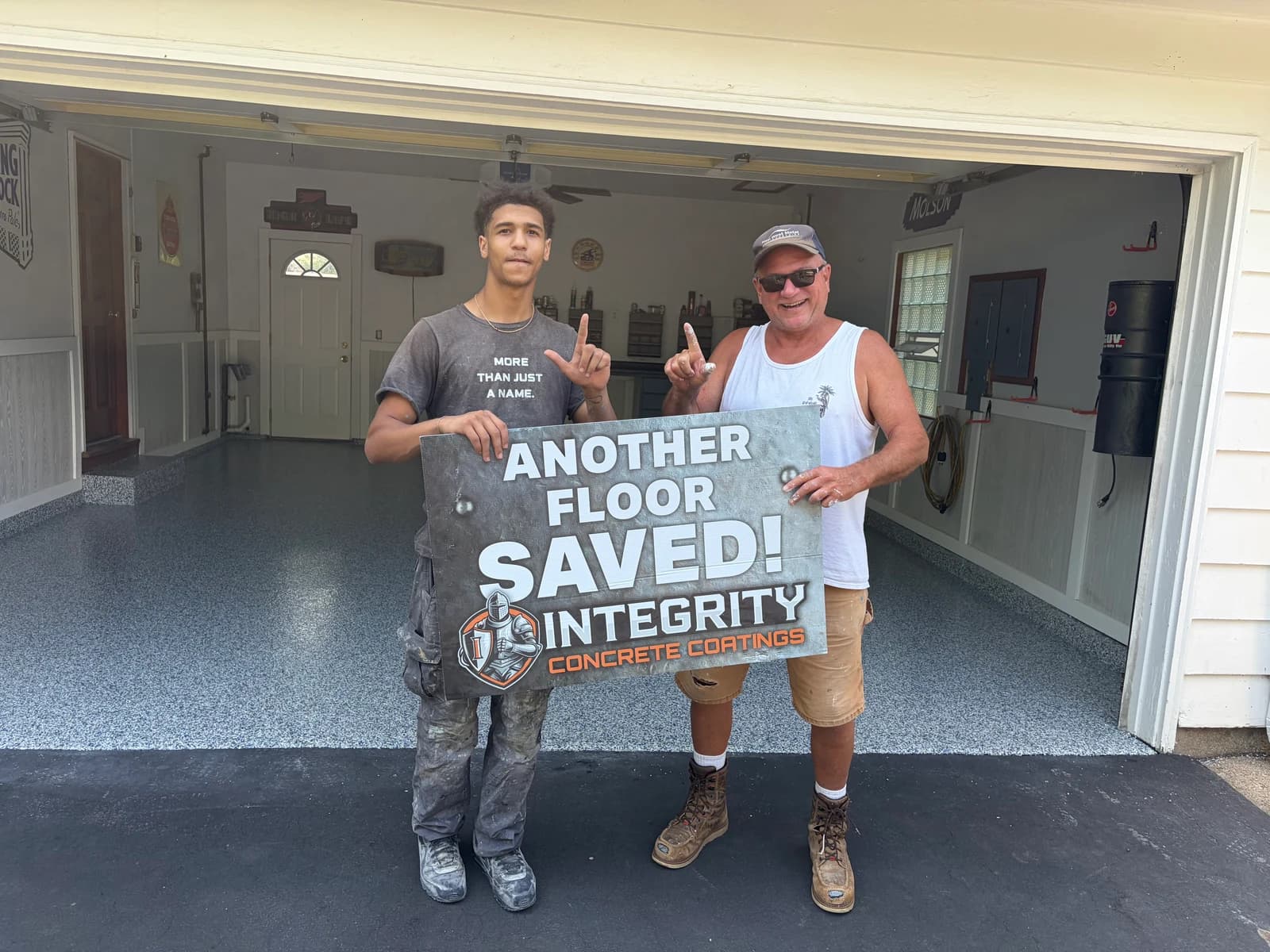
Garage
Whether you searched polyaspartic vs epoxy garage floor or epoxy vs polyaspartic garage floor, this is the surface where the answer matters most. Hot tires, road salt, sunlight through the door and dropped tools all land on one slab, and it is the floor we recommend our system for first. Attached or detached, the garage floor carries a lifetime warranty, backed by The Integrity Seal. The apron outside the door counts as exterior. See our garage floor coatings.
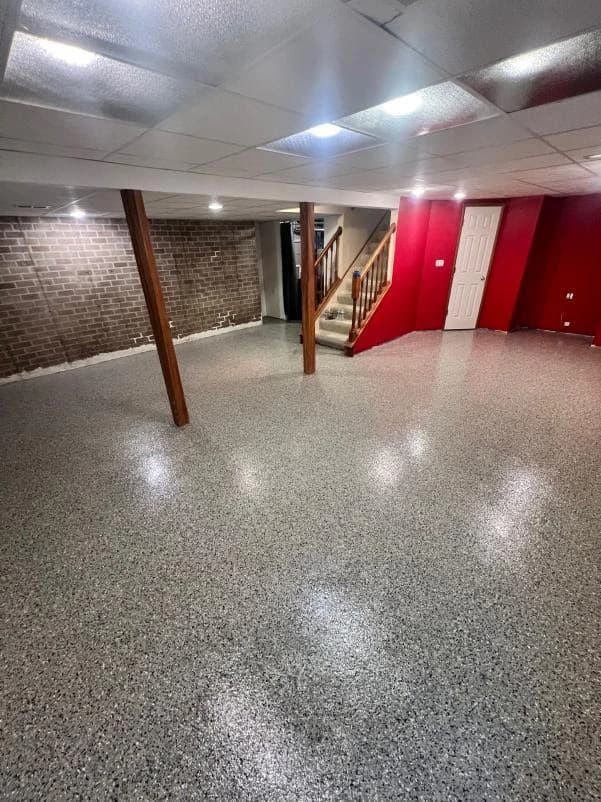
Basement and indoor
No road salt and no hot tires, so the system has an easier life down here. Basement floors carry a lifetime warranty, backed by The Integrity Seal. See basement and indoor floor coatings.

Pool deck and patio
Outdoor concrete gets the sun all day, which is where a UV-stable topcoat pays off. Pool decks can run above our usual price range. See pool deck resurfacing.
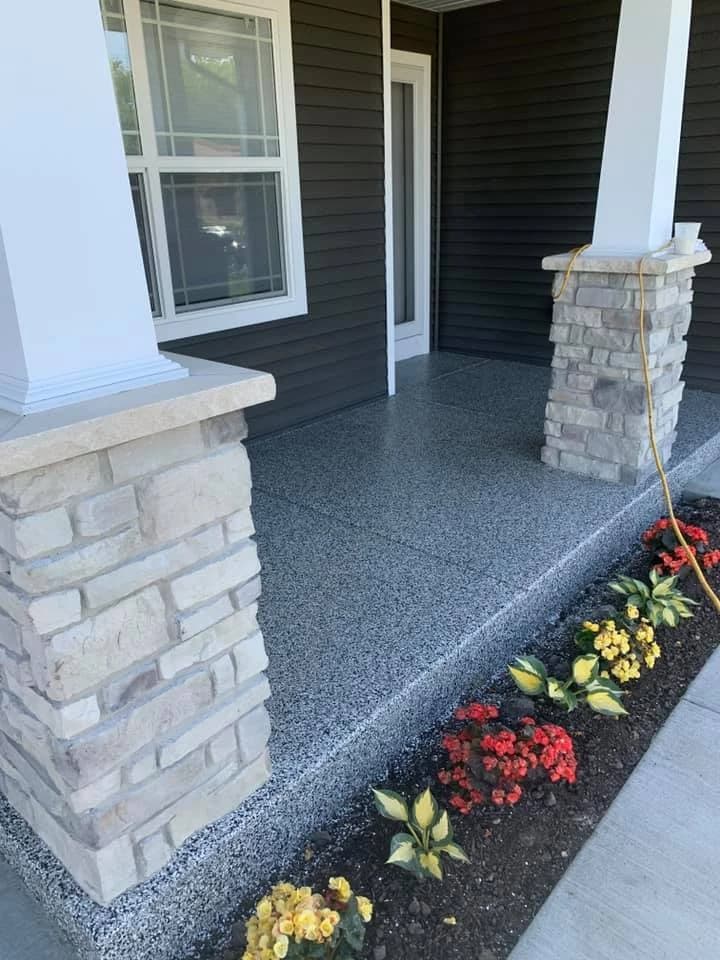
Porch and walkway
Front steps and walkways take sun, snow and salt in the same year. See our walkway and porch coatings.
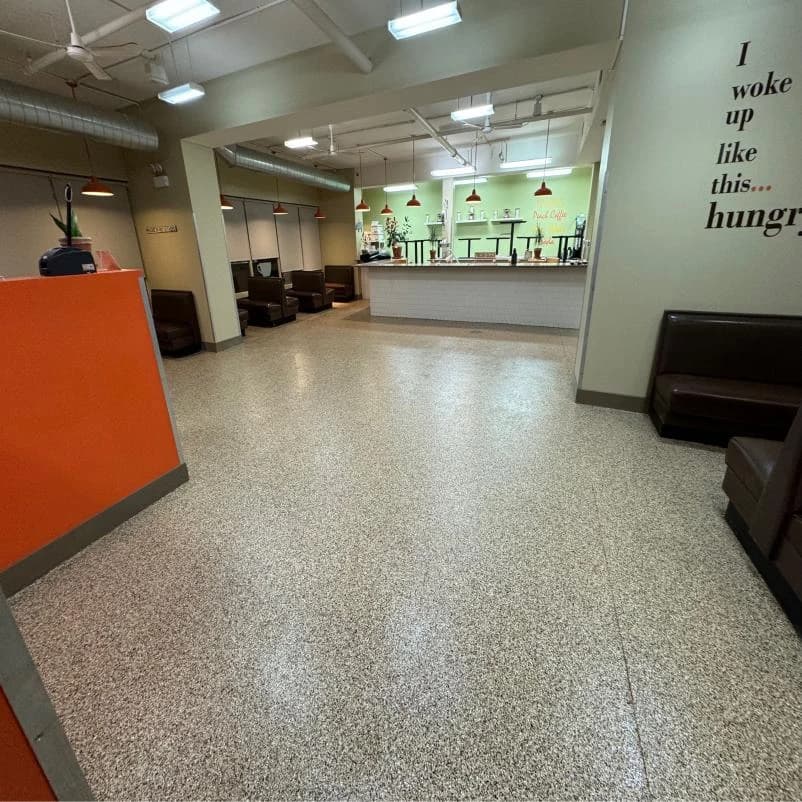
Commercial
This is where epoxy can be the right choice. Some commercial spaces suit it, a slab that has soaked up years of oil being one example, and we assess that job by job. For most, we still recommend the two-layer system, because a one-day install keeps the doors closed for less time. See commercial floor coating.
Industrial
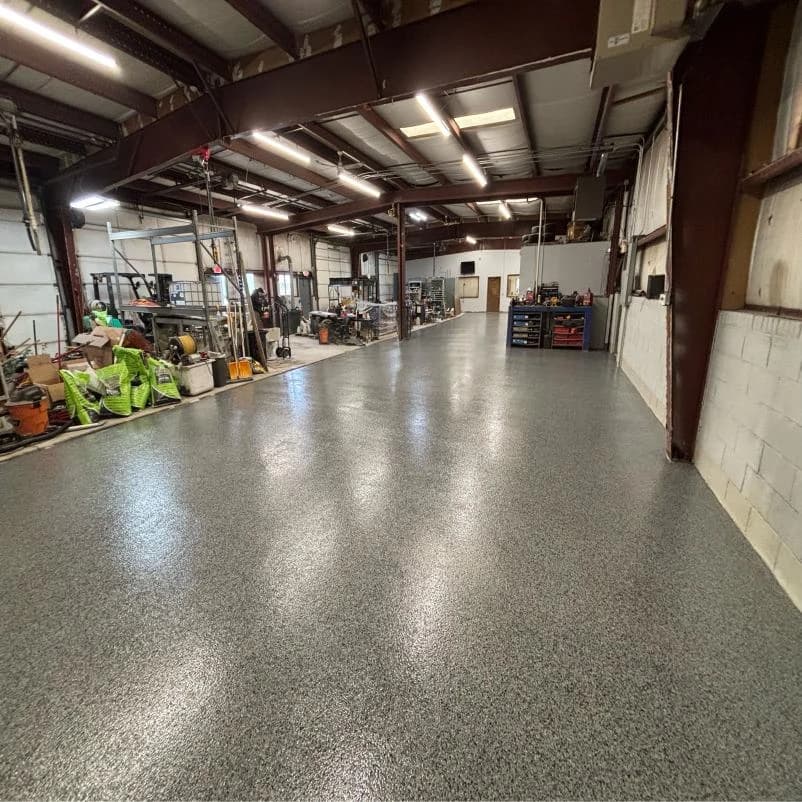
Shops, warehouses and production floors need the impact and chemical resistance in the table above. See our industrial floor coatings.
Finish and color
Whatever the surface, the flake blend sets the look. Browse our flake color options before we come out, and bring a favorite or two to the assessment.
Go deeper

About the author
Lukas Overhaug is an owner of Integrity Concrete Coatings, a family-owned company that has installed concrete floor coatings across Northern Illinois since 2018. He and the crew install the polyurea and polyaspartic system described on this page.
