
By Lukas Overhaug, Owner, Integrity Concrete Coatings
Published
We install across Northern Illinois, from Rockford and DeKalb to the Fox Valley and the western suburbs. See where we work.
01The short answer
Are polyurea and polyaspartic the same thing?
Polyaspartic vs polyurea is a question about two close relatives. Polyaspartic belongs to the polyurea family, so the two are related chemistries, but each is formulated for a different job. At Integrity Concrete Coatings we use both in the same floor. A polyurea base coat goes onto the ground concrete for adhesion and flexibility. A polyaspartic topcoat goes on last for hardness, UV stability and abrasion resistance, with a full broadcast of colored flake between the two. It is the two-layer system we put down on most of the floors we coat across Northern Illinois, from garages to basements to commercial spaces. So the useful answer is to use each one where it does its best work, and the rest of this page explains why. If you are choosing between our system and epoxy instead, start with our polyaspartic vs epoxy comparison.
- layers, each picked for its own job
- 2
- to install both, start to finish
- 1 day
- base coat adhesion, ASTM D4541 pull-off test
- 400+ psi
- until vehicles and heavy items go back in
- 72 hrs
02Two materials, defined
What each one is
What is polyurea?
Polyurea is a two-part coating that cures fast and stays flexible once it has cured. It sets quickly enough that a crew can build a whole floor on top of it in a single day. In our floors it is the base coat. It goes straight onto concrete that we have diamond ground and vacuumed, it grips that concrete, and it can stretch a little as the slab moves through the seasons. People ask us what polyurea coating is, and our answer is short: the flexible layer that holds the floor to the concrete.
The owners describe it as a high-elongation polyurea basecoat that bonds aggressively to prepared concrete. High-elongation means it can stretch before it lets go: the data sheet lists 65 percent elongation. In the ASTM D4541 pull-off test on the product data sheet, our basecoat held at more than 400 psi, and the concrete underneath broke before the bond did. For how that base holds up against a rigid film, read polyurea vs epoxy.
What is polyaspartic floor coating?
Polyaspartic floor coating is a member of the polyurea family formulated as a clear topcoat. It is made to stay stable under UV light, so the floor keeps its color and gloss where sunlight comes through an open garage door or falls across a patio. So if you are asking what is polyaspartic coating, or what polyaspartic floor coating is, the answer is the same product: the clear layer on top of the floor.
In our floors the polyaspartic goes on last. It is hard, it resists abrasion, and it seals the flake layer in. It can also resist oil, gasoline and road salt, and the finished surface is non-porous, so spills and winter slush sit on top until you wipe them up. Fertilizer and harsh chemicals can mark it, so keep them off the floor.
Who does which job
Five jobs a garage floor has to do
- Grip to concretePolyurea base
- Stretch with the slabPolyurea base
- HardnessPolyaspartic top
- Stays clear in sunlightPolyaspartic top
- Resists oil and saltPolyaspartic top
The base is picked for grip and stretch. The top is picked for hardness, UV stability and abrasion resistance. Neither has to be good at the other's job.
03Inside the floor
Polyurea vs polyaspartic: which layer does which job
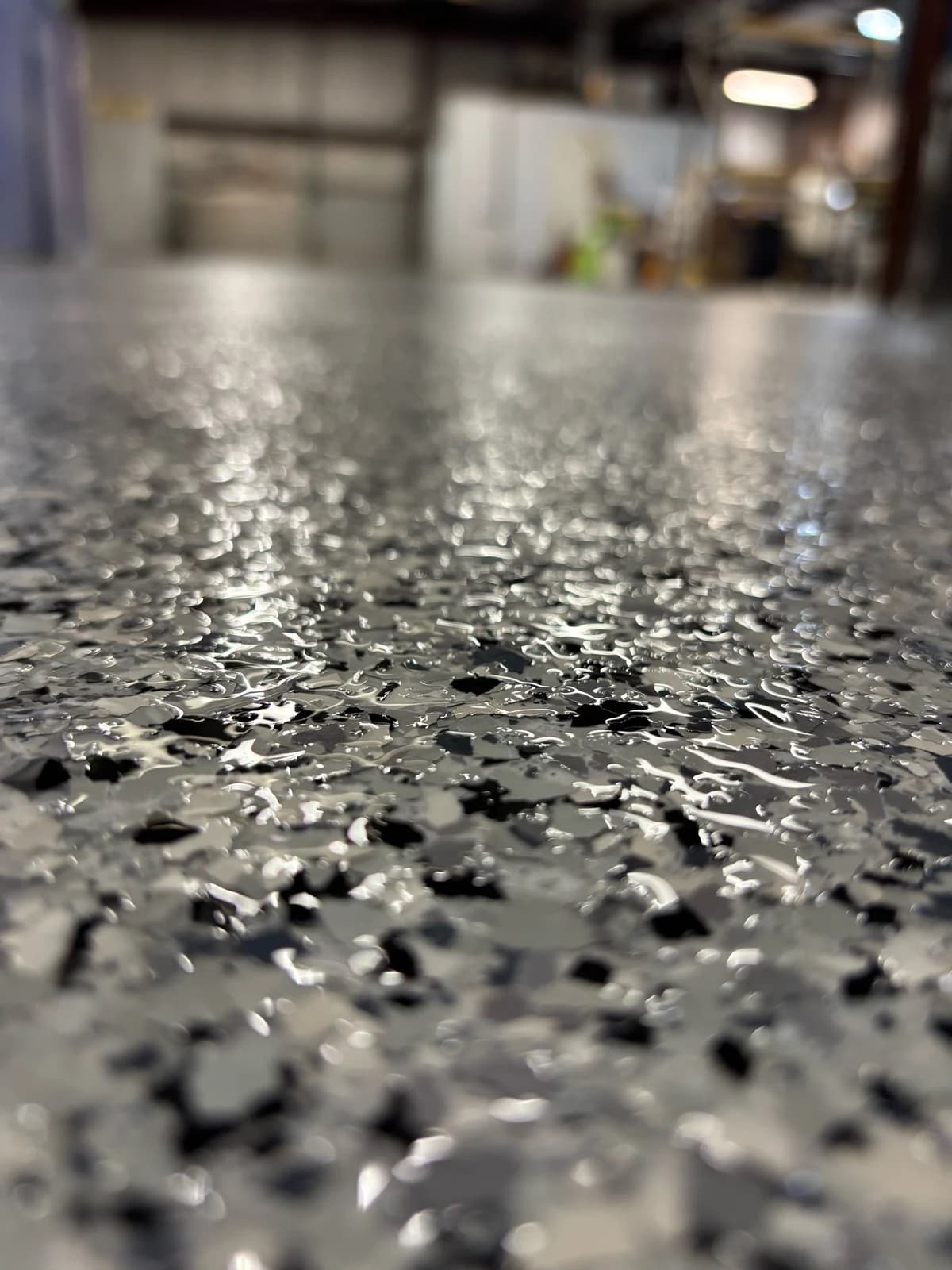
Cut through one of our floors and you would find four layers. At the bottom is your slab, diamond ground so the surface is open. On it sits the polyurea base, which does the gripping and the flexing. Flake is broadcast into the base while it is still wet until the surface is covered, and that gives the floor its color and texture. Over all of it goes the clear polyaspartic topcoat, which takes the wear.
Our system has two layers that do different jobs. We use a high-elongation polyurea basecoat that bonds aggressively to prepared concrete, followed by a full flake broadcast and a hard, UV-stable polyaspartic top coat. The base provides flexibility and adhesion, while the topcoat provides the hardness, abrasion resistance and protection the finished floor needs.
Inside the floor
Four layers, top to bottom. Tap one to lift it out.
Clear, hard and UV stable. It takes the abrasion and the hot tires, can resist oil, gasoline and road salt, and keeps its color where sunlight comes through the door.
Colored flake is broadcast into the wet base coat until the surface is covered. It gives the floor its color and texture. See the finish options.
High-elongation, so it flexes as the slab moves. It bonds to the ground concrete, and in the ASTM D4541 pull-off test reported on the product data sheet, it held at more than 400 psi.
Diamond ground and vacuumed before anything goes down, so the base has clean, open concrete to hold onto.
The split matters most where a floor takes a beating. The base handles what happens underneath: a slab that expands in summer, shrinks in January and moves at its joints. The top handles what happens on the surface, from hot tires and sun to road salt, oil and dropped tools. Each layer is formulated for its half of that list, and neither one is asked to cover the other half. That is what people mean by a polyurea polyaspartic system, and it is how every polyurea polyaspartic floor we install is built.
Want to see the two layers on your own floor?
We will look at the concrete, walk you through the system and give you a written quote. The assessment is free.
04Our reasoning
Why we do not ask one product to do both jobs
The properties a base coat needs and the properties a topcoat needs pull in different directions. The base has to stretch and grip. The top has to be hard and stay clear in sunlight. Those are different properties, so we pick the product formulated for each job instead of looking for one product that covers both.
We use polyurea for its flexibility and adhesion. Compared to polyaspartic, polyurea has a much stronger bond to the concrete. Polyaspartic is a fantastic topcoat, giving the floor UV stability, antibacterial, and anti-microbial properties.
A floor built from a single product asks one layer to do every job at once: hold onto the concrete, move with it, and take the wear on top. Ours splits the work between two layers. That is the whole reason we build it this way.
This is our reasoning about our own floors. It is not a claim about how anyone else's floor performs, and we have no failure figures for single-product floors to show you. What we can show you is what each layer in ours answers to. Tap the numbered spots in the garage below.
Simplified drawing. Tap a numbered spot.
What lands on a garage floor
Hot tires
Answered by: the polyaspartic top
Tires come home hot from the road and sit on the same two strips every night. The polyaspartic top is hard, so it takes the heat and the wear, and installed properly the system resists hot tire pickup.
Four of the five land on the surface, which is why the top is the hard layer. The one that comes from underneath, a slab that moves, is the job of the base, and a dropped tool asks something of both.
05The result
What polyurea and polyaspartic together mean for your floor
- One day to install. The base, the flake and the topcoat all go down on the same day.
- UV stable at the garage door, so the strip where the sun reaches keeps its color.
- Flexible through freeze-thaw, because the base moves with the slab.
- Resists hot tire pickup when installed properly.
- Can resist oil, gasoline and road salt.
And the floor comes back in three steps, counted from when we finish:
- 24 hourswalk on it.
- 48 hoursmove small items back in, anything under 100 pounds.
- 72 hoursheavy items and vehicles. The floor is back in full use.
With proper maintenance, the floor can last a lifetime. Residential floors under a roof, garages included, carry a lifetime warranty, backed by The Integrity Seal. Patios, pool decks, porches, walkways, garage aprons and commercial floors carry a 3-year warranty with the same coverage. The lifetime warranty transfers to the next owner of the home.
Most of the floors we coat are garages, so start with our garage floor coatings if that is your project. If you are budgeting, our page on polyaspartic floor coating cost has the range and what moves it. When you are ready, book a free floor assessment and we will measure the floor and give you a written quote.

About the author
Lukas Overhaug is an owner of Integrity Concrete Coatings, a family-owned company that has installed concrete floor coatings across Northern Illinois since 2018. He and the crew install the polyurea and polyaspartic system described on this page.
