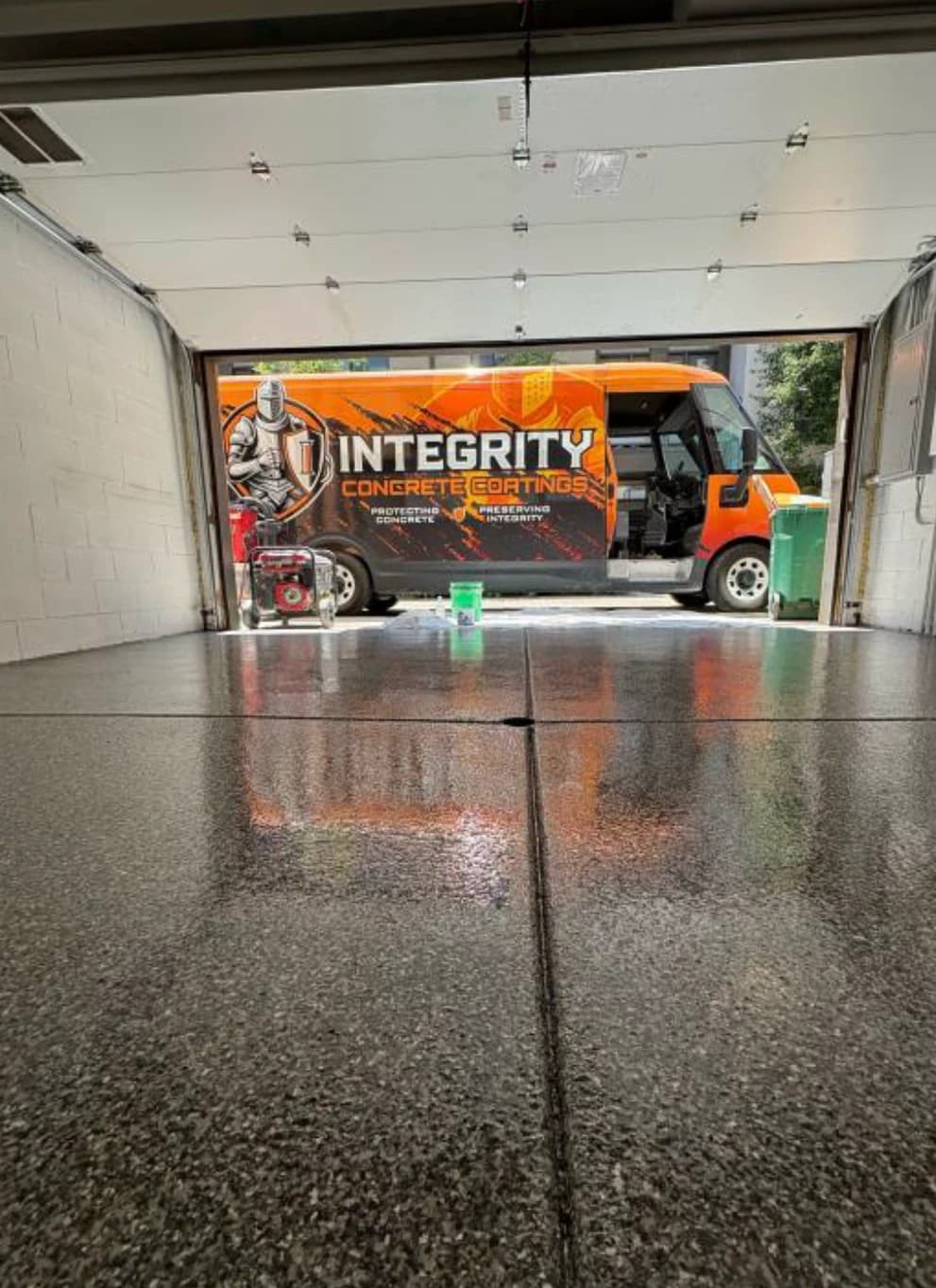

By Lukas Overhaug, Owner, Integrity Concrete Coatings
Published
We install across Northern Illinois, from Rockford and DeKalb to the Fox Valley and the western suburbs. See where we work.
When someone searches for the best garage floor coating, the question underneath is simpler: which one will still look right after five Northern Illinois winters? The short answer is a polyurea base with a polyaspartic topcoat, installed over a diamond-ground slab. That is the system that wins our polyaspartic vs epoxy comparison and the one we install as our garage floor coating. The rest of this page shows the work: what a garage floor here has to survive, how each option holds up, which one fits which garage, and what ours costs. We install floors for a living, so read the ranking knowing where we stand, and check it against the reasons.
01The test
What the best coating for a garage floor has to survive here
Most coating advice is written for a showroom floor in a mild climate. A garage in Northern Illinois is a harder place. These six things do the damage, and every option below is judged on them.
- Hot tires on the same two stripsA car comes home with warm tires and parks on the same two strips every night. A coating that softens with heat grips the tread and leaves with the tire in the morning.
- Sunlight through an open doorThe strip inside the door gets daylight for hours. A coating that is not UV stable turns amber there first, and the floor ends up two colors.
- Road salt from November to MarchSalt rides in on the tires and melts into a puddle of brine. On bare concrete it soaks in and pits the surface. On a sealed floor it sits on top and wipes up.
- A slab that expands in July and contracts in JanuaryConcrete moves with the temperature, and here it moves a lot. A rigid film cracks where the slab flexes. A flexible base rides it.
- How long the garage is out of useA multi-day install with a week of cure is a week of cars in the street. A one-day install with a 72-hour return to parking is a long weekend.
- What the warranty actually coversPaint and kits come with a return policy at best. A professional floor should come with a written warranty that names peeling, delamination, chipping, blistering and UV discoloration.
From our job files
Salt season on a sealed floor
From November to March the floor under the car is a puddle of road salt most mornings. On bare concrete that brine soaks in and pits the surface a little more each winter. On a sealed floor it dries to a white ring and wipes up. That one difference is most of what a coating is for here.
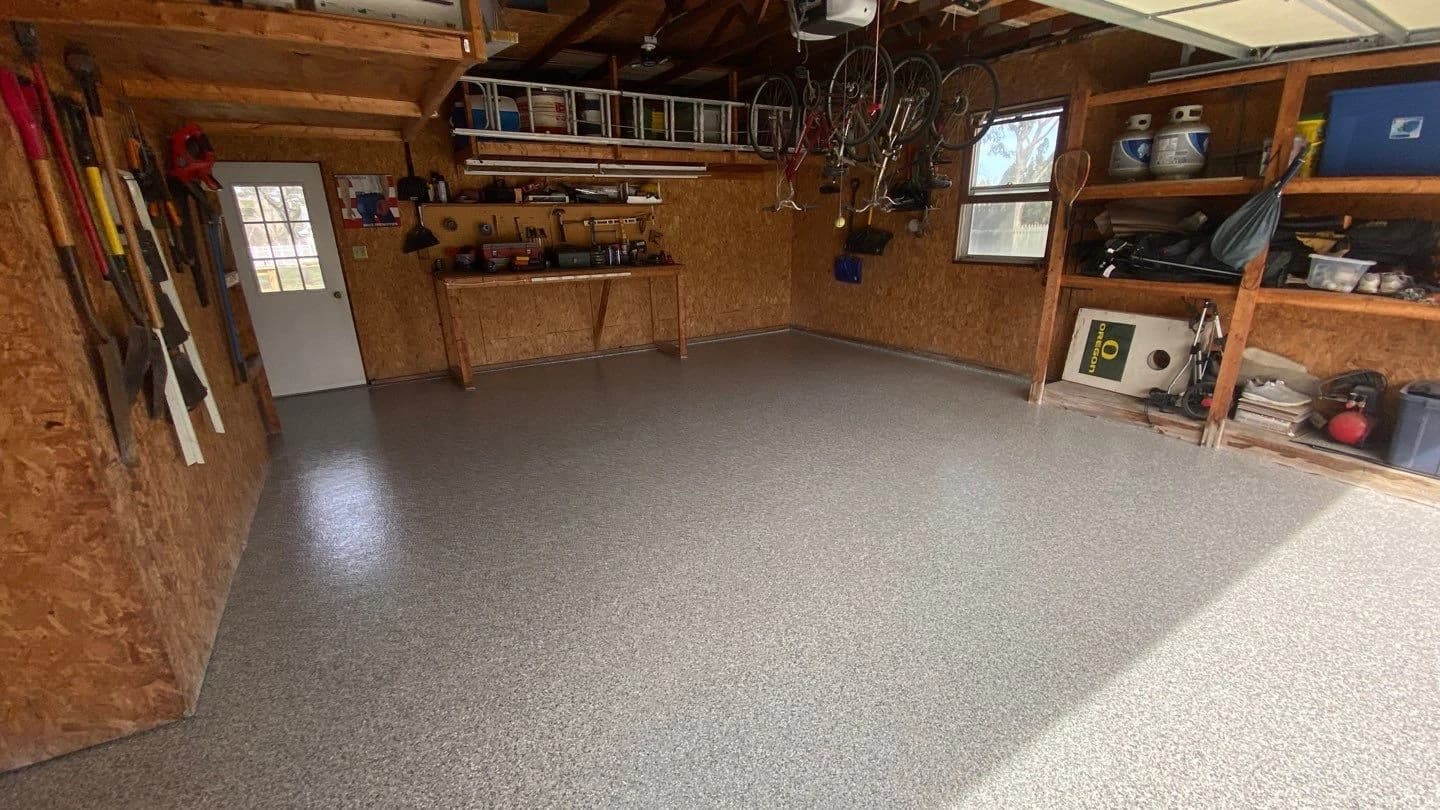 Flake garage floor
02The ranking
The garage floor coating options, ranked
The best garage floor coating system for this climate is the one that passes all six tests, and only one option does. The seven below are every option a homeowner is likely to price, from the floor we install to the one that is not a coating at all. Each gets a verdict, what it does well, where it fails, a cost band in words and who it suits.
- Polyurea base with a polyaspartic topcoat: Our pick, and what we install.
- Polyaspartic alone: A good topcoat asked to do two jobs.
- Polyurea alone: The right base, the wrong top.
- Professional-grade epoxy: Hard, thick and rigid.
- DIY epoxy kit: A thin film over etched concrete.
- Garage floor paint: The cheapest option and the shortest-lived.
- Interlocking tiles and mats: Not a coating at all.
Rank them your way
What matters most in your garage? Pick one or more.
Showing our ranking. Pick what matters most in your garage and the list reorders.
| Option | Hot tires | Sunlight | Road salt | Slab movement | Downtime | Warranty |
|---|---|---|---|---|---|---|
| What we installPolyurea base with polyaspartic topcoat | Resists hot tires | UV stable topcoat | Sealed, wipes clean | Flexes with slab | One day install | Written lifetime warranty |
| Polyaspartic alone | Hard wearing surface | UV stable | Sealed surface | Less give | Fast cure | Depends on installer |
| Polyurea alone | Softer surface | Ambers in sun | Sealed surface | Most flexible | Fast cure | Rarely offered alone |
| Professional-grade epoxy | Hot tire pickup | Can yellow | Sealed surface | Rigid film | Multi-day install | Varies by installer |
| DIY epoxy kit | Lifts first | Rarely UV stable | Sealed while intact | Thin and rigid | Weekend plus cure | Return policy |
| Garage floor paint | Wears through | Fades, chalks | Peels with moisture | Cracks, peels | Afternoon to roll | None |
| Interlocking tiles and mats | Tiles hold up | Mostly colorfast | Salt goes under | Tiles can crack | Usable same day | Product warranty only |
Seven options against the six things that wear a garage floor out here. A check means it handles that test, a dash means a weak point. Swipe sideways on a phone to see every column.
Polyurea base with a polyaspartic topcoat
Our pick, and what we install.
What it does well. Two layers doing two jobs. The polyurea base bonds to diamond-ground concrete at more than 400 psi on the basecoat data sheet and stretches 65 percent before it gives, so it rides the slab through every freeze and thaw. The aliphatic polyaspartic topcoat is UV stable, hard enough for hot tires when installed properly, and cures fast enough that the whole floor goes in on one day, year round.
Where it fails. It costs more up front than paint or a kit, and it is not a weekend project. The grinding, the materials and the short working time call for a crew that does it every day. Skip the grinding and even this system lets go, which is why the prep matters more than the product.
Cost. The mid to upper part of the professional range. For our own floors, $6 to $10 per square foot installed.
Who it suits. A daily-driver garage, attached or detached, and anyone who wants to coat the floor once.
Polyaspartic alone
A good topcoat asked to do two jobs.
What it does well. Polyaspartic is what makes a one-day install possible. It is UV stable, hard, chemical resistant and quick to cure, which is why it is the top layer of our own floor.
Where it fails. Without a flexible base under it, a single-material floor has less give over a slab that moves. The fast cure also means a small working window, so a crew that is not set up for it leaves thin spots and roller marks on a warm day.
Cost. The professional range, often close to a two-layer floor.
Who it suits. A newer, sound slab with an installer who works fast, where color stability matters more than flexibility.
Polyurea alone
The right base, the wrong top.
What it does well. Polyurea has the best adhesion and the most stretch of anything on this list. It bonds hard to prepared concrete and moves with it, which is the whole reason it is the base of our system.
Where it fails. On its own, the polyurea used as a base coat is not UV stable, so it ambers where daylight reaches the floor, and its surface is softer than a polyaspartic top, so it scuffs in the tire paths. It belongs under a topcoat, not on top.
Cost. Professional pricing for a floor that still needs a topcoat.
Who it suits. Nothing in a garage on its own. Under a polyaspartic topcoat, almost everything.
Professional-grade epoxy
Hard, thick and rigid.
What it does well. A professional 100 percent solids epoxy floor is thick, hard and chemical resistant, and in a heated commercial space with no sun through the door it does a fine job. We install it on some commercial jobs where it suits the space.
Where it fails. A garage hands it the three things it handles worst. It is rigid, so it fights a moving slab. It is not UV stable, so it yellows inside the door. And it softens under a hot tire, the classic epoxy garage failure. The install runs two to four days, with the cure on top.
Cost. The professional range, often a little under a two-layer floor.
Who it suits. A heated shop or commercial floor with no direct sun and no daily hot tires.
For the full table, see polyaspartic vs epoxy.
DIY epoxy kit
A thin film over etched concrete.
What it does well. The kits are cheap, on the shelf at every home center, and a careful homeowner can follow the instructions. On a new, dry slab with little sun, a kit can look fine for a season or two.
Where it fails. Most kits prep the slab with an acid etch instead of grinding, so the film has little to grip. The film is thin and rarely UV stable. The result is the floor people picture when they hear the word epoxy: peeling in the tire paths and yellow near the door, usually within two years.
Cost. The lowest cost per square foot of any coating, plus a weekend and a few days of cure.
Who it suits. A floor you plan to redo, or a storage garage with no car and no sun.
Garage floor paint
The cheapest option and the shortest-lived.
What it does well. A gallon of floor paint and a roller will change the color of a garage in an afternoon, for less than anything else on this list.
Where it fails. Paint sits on the surface rather than bonding into ground concrete. It wears through in the tire paths within a season, chalks in sunlight and peels wherever moisture comes up through the slab.
Cost. The least of any option, and the most often repeated.
Who it suits. A rental you are about to leave, or buying a year before a real floor.
Interlocking tiles and mats
Not a coating at all.
What it does well. Tiles and mats need no prep and no chemistry. They go down in an afternoon, can be lifted and moved, and hide an ugly slab on day one.
Where it fails. They do not seal the slab. Salt and melt water run through the seams and sit on bare concrete, so the slab keeps pitting and the floor stays damp. Dirt collects in the joints, mats shift under a turning tire, and some tiles crack in a cold garage.
Cost. Between a kit and a professional floor.
Who it suits. A renter, or a slab that cannot be coated because of moisture.
03Your garage
Best garage floor coating by situation
The ranking holds for most garages, but not every garage is most garages. Five cases come up more than the rest.
A daily-driver attached garage
Hot tires, salt and sun through the door, every day. This is the floor the two-layer system was built for. See what our garage floor coating includes.
A detached, unheated garage
The same system. The best garage floor coating for cold climates is the one that installs in them: ours goes down year round, including below freezing, and the cold only stretches the cure. The install and cure section of our comparison has the schedule.
A shop with a lift or heavy equipment
Point loads from a lift and dropped tools call for a thick build and a hard top. We coat shop floors with the same two layers, and where epoxy suits the space we say so. Start with our commercial floor coatings.
A garage with failing epoxy on it now
Nothing bonds to a coating that is letting go, so the old film comes off first. Our guide to hot tire pickup covers why it failed and what replacing it involves, and polyurea vs epoxy explains why the next floor should start with a flexible base.
A tight budget
Paint or tiles buy time, and that is fine if you know that is what you are buying. A professional coating is the one you do once. If the number is the question, read polyaspartic floor coating cost first.
Which one fits your garage
Four taps, one plain recommendation.
Question one of four
Is the garage attached to the house or detached?
04The weekend options
Garage floor paint and DIY epoxy kits against a professional coating
Most people who search for the best garage floor epoxy are looking at a kit, and most who search for the best garage floor coating DIY can do with a roller are looking at paint. Both are honest products. The problem is what they are asked to do.
A kit fails for three reasons. The prep is an acid etch, which roughens the surface without opening it the way grinding does. The film is thin, because a homeowner cannot roll a thick two-part coating before it sets. And it is rarely UV stable, so the strip inside the door goes amber first. Put a hot tire on that film every night and the tire paths peel within a couple of years. What a kit is good for is buying time on a floor you plan to redo. Our post on painting your garage floor with epoxy goes through the kit and the professional system step by step.
And the honest answer to what the best floor paint for a garage floor is: it is the cheapest option on this page and the shortest-lived. Two years in, you have paid for the paint, the weekend, and the grinding that has to remove it before a real coating can go down.
05The floor we put our name on
What we install, and why it ranks first for us
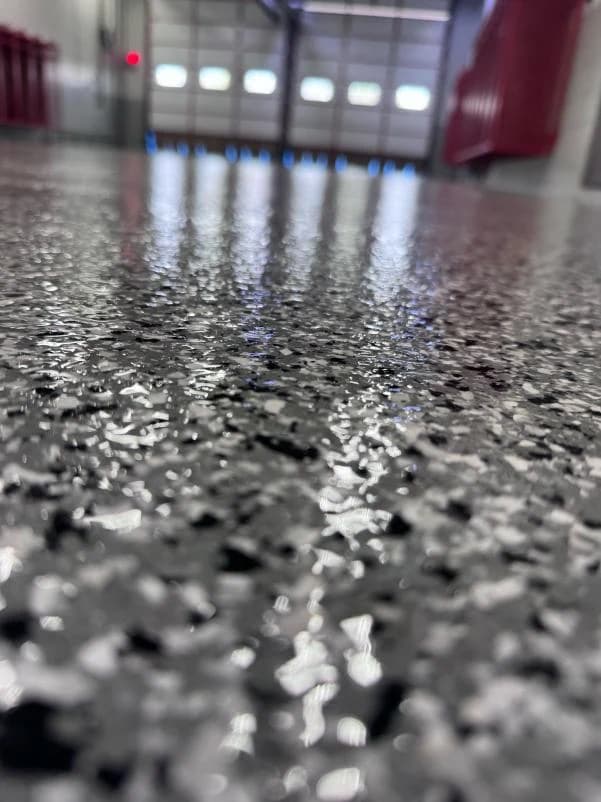
Every garage we coat gets the same two layers. The slab is diamond ground first, so the base has open concrete to grip. The polyurea base goes down next and bonds at more than 400 psi on the basecoat data sheet, with 65 percent elongation, so it stretches with the slab instead of cracking. The flake is broadcast into it while it is wet. Then the clear aliphatic polyaspartic topcoat seals the floor, holds its color in sunlight and takes the hot tires and the wear. The whole install takes one day on most garages, year round, including below freezing. Epoxy still has a place: on some commercial jobs it suits the space, and we install it there.
Return to service after the install
Cure clock
Drag to see what you can do, and when
after we finish
Still curing
Stay off the floor. Cold weather can stretch this part, and the longer cure does not hurt anything.
Walk on it
Small items back
Vehicles and heavy items
Residential floors under a roof, garages included, carry a lifetime warranty, backed by The Integrity Seal. Patios, pool decks, porches, walkways, garage aprons and commercial floors carry a 3-year warranty with the same coverage. See our garage floor coating for how the day goes, and browse the flake colors and finishes before you pick a blend. We install it across the region, from garage floor coating in Aurora to garage floor coating in Rockford, and in the towns between.
Want a written number before anyone touches the floor?
We come out, check the slab, measure it and put the price in writing. The on-site quote is free.
06Cost and the day itself
What a garage floor coating costs and how long it takes
Most garages we coat come in at $6 to $10 per square foot, installed. Three things move a job inside that range or above it: slab repair, an old coating that has to come off first, and the amount of flake in the finish. Our polyaspartic floor coating cost guide has the full breakdown and a calculator for your square footage.
The day runs like this. The crew grinds and vacuums the slab in the morning and repairs cracks and pits. The polyurea base goes down around midday and the flake is broadcast into it. By the afternoon the loose flake is scraped back and the polyaspartic topcoat seals the floor. You walk on it after 24 hours, put small items back after 48 and park after 72.
Go deeper

About the author
Lukas Overhaug is an owner of Integrity Concrete Coatings, a family-owned company that has installed concrete floor coatings across Northern Illinois since 2018. He and the crew install the polyurea and polyaspartic system described on this page.
